About
History & Traditions
A mill town, a millpond, a school on the hill above it, and a bell that has rung every school morning since 1889.
A ford over the mere
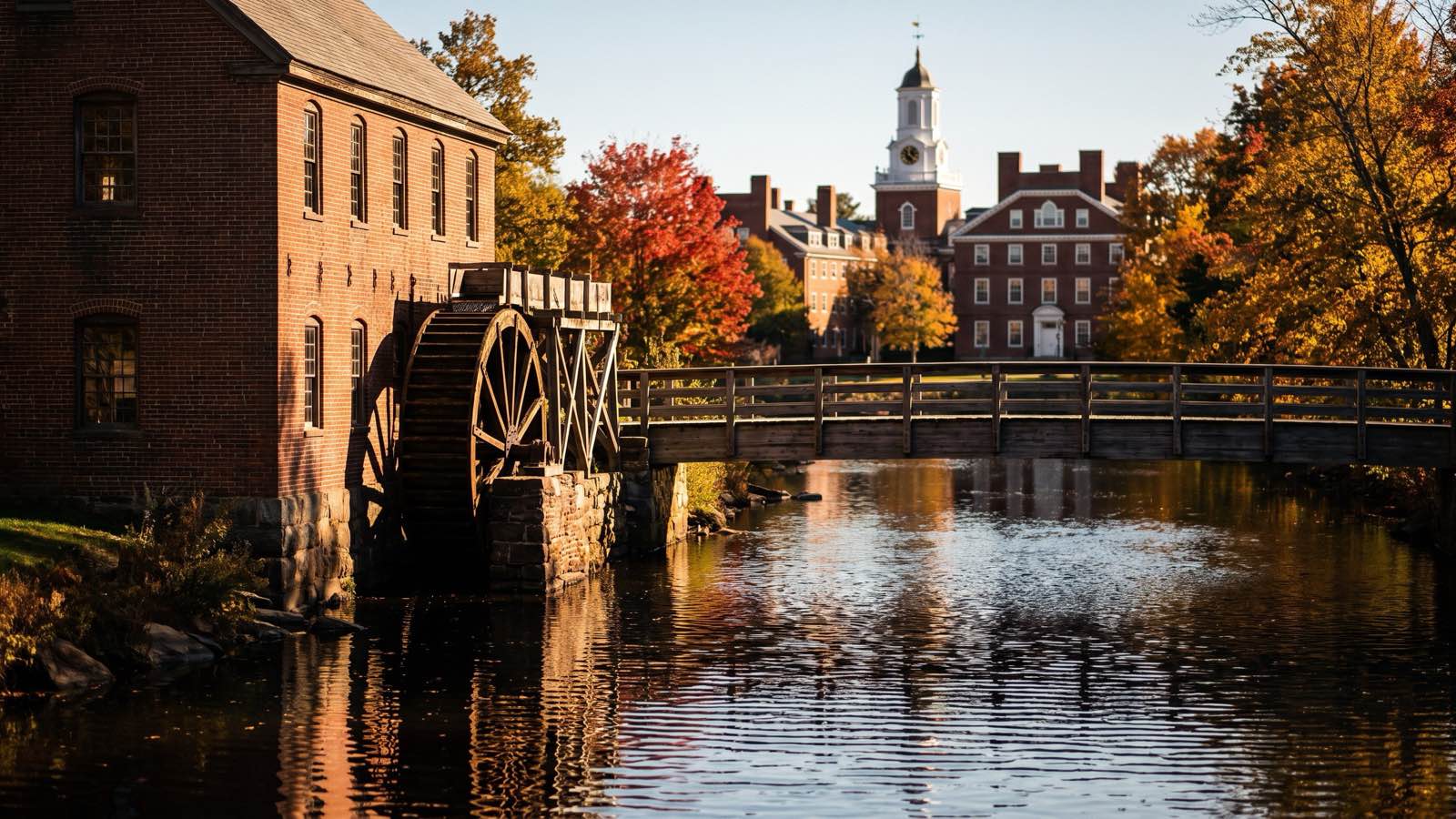
Mereford is older than the school. The town grew around a ford where the Quinnetuck widens into a millpond — the mere — and by the middle of the nineteenth century it had three mills, a church and more boys than schooling. In 1887 Josiah Ashcroft, who owned the largest of the mills, and his wife Abigail, who had taught before her marriage, chartered an academy for the town's sons and put two masters and twelve boys into a house on Mill Street. Two years later Ashcroft Hall opened on the hill, with a clock tower and a bell cast in Troy, New York. The bell is still rung by hand at 7:45 on every school morning, and the tower is still the Belltower to everyone who has ever been late for it.
The school boarded its first students from outside the valley in the 1890s, built Hartwell Library after the First World War and the Chapel of St. Dunstan after the next, and went coeducational in 1971. The centennial brought the Quinnetuck Science Center and the postgraduate year; the old mill itself became the Millbrook Arts Center in 2004. Through all of it the school stayed small, and the faculty stayed on campus.
The crest
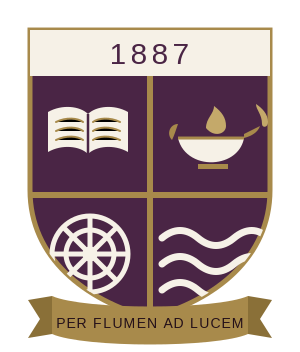
A plum shield quartered by a thin brass cross: an open book for the classroom, an oil lamp for the hours after it, a mill wheel for the town, and three wavy bars for the river. The ribbon beneath carries the motto, Per Flumen Ad Lucem, and the chief carries the year of the charter. The colors are plum and old brass, chosen (the minutes record) because the trustees could not agree on blue.
Milestones
A short chronology
| Year | Event |
|---|---|
| 1887 | Josiah and Abigail Ashcroft charter the Mereford Academy for the sons of the mill town, with twelve boys and two masters in a house on Mill Street. |
| 1889 | Ashcroft Hall opens on the hill above the millpond. Its bell, cast in Troy, is hung the same autumn. |
| 1921 | Hartwell Library is given by the family of a founding trustee. |
| 1931 | The Chapel of St. Dunstan is consecrated; the first Lessons and Carols is sung that December. |
| 1946 | The Fieldhouse opens; the first Millrace games are played against Wyckholm School. |
| 1971 | Mereford becomes coeducational. Linden and Holloway Houses open. |
| 1988 | The centennial year: the Quinnetuck Science Center opens and the postgraduate year is added. |
| 2004 | The Millbrook Arts Center opens on the site of the old mill. |
| 2019 | Dr. Eleanor V. Hargrove becomes the eleventh Head of School. |
| 2024 | Vaughan Health Center is renovated. |
| 2026 | Grades and reporting move to the Mereford Portal. |
Traditions
What every Mereford student knows
Head's Holiday
Once a year, on a morning no one is told about in advance, the Belltower rings at 7:00 instead of 7:45 and the day is given back to the school: no classes, no practices, a long brunch in the Refectory. The Head chooses the day; the faculty are not warned either, which is the point.
Prize Day
The Saturday before Commencement. The school's prizes and awards are read out on the Quad, and the senior class walks once around it, by tradition counterclockwise, before lunch with their families.
The Millrace
The fall rivalry with Wyckholm School, played at home and away in alternate years since 1946. Every varsity team plays the same day; the Millrace trophy, a brass mill wheel, is presented at dinner and kept for a year by whichever school won more contests.
The Lamp Ceremony
On the first evening of the year, new students are given a small brass lamp by a senior in the Chapel of St. Dunstan and carry it, lit, across the Quad to their house. The lamps are returned on Prize Day.
Lessons and Carols
Readings and music in the Chapel on the last Friday before the winter recess, sung by the choir and the chamber players since 1931. The town is invited; the Chapel is always full.